
How to Travel Around the World by Plane: Organization, Duration, and the Air Cruise Concept
To travel around the world by plane under optimal conditions of comfort and time, the most effective solution is the air cruise aboard a fully privatized aircraft. Unlike regular flights that impose technical stopovers and tedious connections, this concept enables a high-end around-the-world circuit to be completed directly. The ideal duration for an around-the-world air journey is approximately 25 days, allowing travelers to connect the planet’s greatest sites without fatigue through a turnkey around-the-world organization.
Undertaking a journey around the world by plane is the ultimate achievement for any seasoned traveler. It is the promise of watching the sun rise over the temples of Angkor, contemplating the moai of Easter Island, and falling asleep facing the lagoons of Polynesia—all within a single voyage. Yet the realization of this dream often collides with a logistical reality of immense complexity: multiple tickets, disrupted time zones, interminable waits in terminals, and anxiety-inducing baggage transfers.
Faced with these constraints, discerning travelers now turn to exceptional alternatives. How does one plan such an adventure? What is the perfect duration to appreciate each stopover without suffering from jet lag? Discover the keys to flawless organization and the workings of the air cruise, the modern answer to exceptional travel.
Table of Contents
- Different Ways to Travel Around the World by Plane
- How Long Does an Around-the-World Air Journey Take?
- How to Organize a Prestige Around-the-World Air Journey?
- Focus on the High-End Air Cruise: How Does It Work?
- Comparison Table: Regular Airlines vs. Private Air Cruise
- In Summary: Key Takeaways
- FAQ: Your Frequently Asked Questions About Around-the-World Travel
Different Ways to Travel Around the World by Plane
When studying how to organize an around-the-world air journey, two major travel philosophies emerge. The first involves logistical craftsmanship on commercial airlines, while the second favors the exclusivity of private aviation.Regular Flights and Commercial Alliances: A False Good Idea?
The traditional method consists of purchasing a single-ticket around-the-world flight from major airline alliances (Star Alliance, OneWorld, or SkyTeam). While this option offers apparent freedom, it imposes major geographic and temporal constraints:- The obligation to travel always in the same direction (East to West, or West to East).
- Mandatory passage through major global airport hubs (London, Dubai, Singapore), which considerably lengthens travel time and multiplies unwanted around-the-world stopovers.
- Even when booking First Class or Business Class, travelers endure airline schedules, connection delays, and the repeated ordeal of security checks and baggage check-in at every border.
Private Aircraft and Air Cruise: Excellence in Direct Travel
In contrast to this fragmented model, the modern luxury around-the-world journey is organized around the concept of air cruise or around-the-world travel by private aircraft. Here, transportation is no longer an endured constraint between two destinations, but the fluid, refined thread connecting the entire journey. A high-end aircraft is chartered for a limited group of passengers. It serves each around-the-world itinerary point-to-point, without unnecessary technical stopovers. The aircraft awaits its passengers on the tarmac while they explore the destination, definitively eliminating the stress of schedules and missed flights.How Long Does an Around-the-World Air Journey Take?
Determining how long an around-the-world air journey takes is the first crucial planning step. The answer depends directly on the chosen mode of transport and desired comfort level.Duration Analysis: From Extended Voyage to Optimized Format
If you opt for regular airlines, an around-the-world journey generally requires between 3 and 6 months to be properly appreciated. Why? Because time lost in transfers, stopovers, and physical recovery after each long-haul commercial flight consumes an immense portion of your schedule. For active executives or senior travelers who refuse to sacrifice their comfort and health, this extended approach proves exhausting and incompatible with a demanding schedule.Why Is the 25-Day Around-the-World Air Journey the Ideal Format?
Thanks to the performance of direct flights on private aircraft, the 25-day around-the-world air journey has established itself as the absolute standard for premium around-the-world travel. This three-and-a-half-week duration offers incomparable physiological and logistical advantages:- Flight time optimization: By eliminating connections, a flight between two continents that would normally take 24 hours on regular airlines is reduced to a direct flight of 8 to 10 hours.
- Preservation of biological rhythm: The itineraries of a high-end around-the-world circuit are calculated to follow the sun progressively. Flights occur primarily during the day, in spacious lie-flat seats, drastically limiting the effects of jet lag.
- Intensity of discoveries: In 25 days, it is possible to discover 7 to 8 legendary destinations (for example: Machu Picchu, Easter Island, French Polynesia, the temples of Angkor, Kathmandu, Luxor) without ever experiencing the weariness of a traveler in transit.
How to Organize a Prestige Around-the-World Air Journey?
Crafting an organized around-the-world journey at this level of excellence requires tourism engineering expertise that only a rare few specialists possess.The Complexity of Administrative Logistics and Visas
Attempting to design such an itinerary oneself amounts to a diplomatic and administrative puzzle. Each country crossed imposes its own entry rules. Obtaining tourist visas for China, Egypt, or certain African countries on a single passport, within a limited timeframe, requires months of complex procedures. When selecting a turnkey around-the-world organization, all these formalities are handled by the agency. Visas are anticipated, landing and overflight fees are negotiated in advance with each country’s civil aviation authorities, ensuring priority and seamless entry at every border.Selection of Accommodations and Creation of an Exceptional Itinerary
A luxury around-the-world journey tolerates no approximation regarding ground services. The organization must simultaneously secure:- Stays in the world’s finest palaces, eco-responsible lodges, or legendary hotels (properties ranked among the most beautiful in the world).
- Private French-speaking guides who are experts in their field at each stopover.
- Secure private transfers directly from the aircraft gangway.
Focus on the High-End Air Cruise: How Does It Work?
A true revolution in ultra-luxury travel, the air cruise transposes the spirit of the great maritime cruises of yesteryear into the vastness of the sky.The Principle of a Fully Privatized Aircraft from Start to Finish
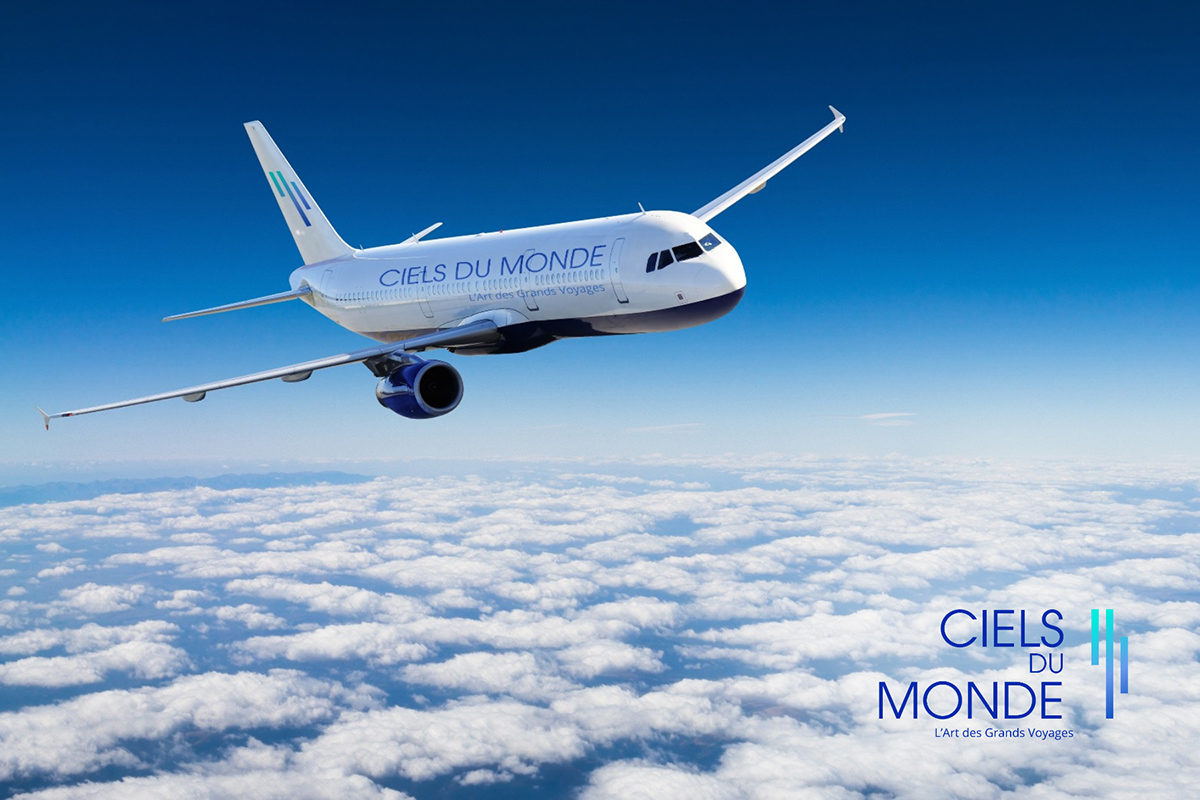
Air cruise: how does it work? The concept is based on the privatization of a state-of-the-art airliner (Airbus or Boeing type), whose cabin has been entirely reconfigured for premium comfort. Where traditional airlines install 300 narrow seats, Ciels du Monde departs with 150 passengers seated in comfortable seats. The strength of this arrangement lies in its permanence. You board in Paris, and this aircraft becomes your flying salon for the entire journey. Each day you return to your assigned seat, your routines, and a dedicated crew that learns your preferences (beverages, pillows, reading materials).VIP Service on the Ground and in the Air
The high-end experience unfolds at every moment of the journey:- Door-to-door baggage management: You entrust your luggage in Paris. At each stopover, you find it delivered directly to your hotel room. You never carry it, never check it, and never wait for it on an airport carousel. (Except in rare cases)
- Life on board: The onboard gastronomy is worthy of fine dining establishments, accompanied by fine wines and champagnes from prestigious vintners. An onboard physician and experienced support staff ensure the smooth running of the journey 24/7.
Comparison Table: Regular Airlines vs. Private Air Cruise
| Evaluation Criteria | Around-the-World on Regular Flights (Alliances) | Private Air Cruise (Ciels du Monde) |
| Travel Time & Flights | Multiple stopovers, mandatory connections, imposed hubs. | Direct point-to-point flights, no connections. |
| Baggage Management | Check-in and retrieval at each flight. High risk of loss. | Complete door-to-door handling. |
| Formalities and Customs | Standard queues, individual visa management. | Fast-track, simplified formalities, visas managed in advance. |
| Flexibility & Serenity | Fixed airline schedules, stress of delays. | The aircraft waits for travelers. Absolute serenity. |
| Ground Accommodations | Disparate reservations to coordinate yourself. | Palaces and harmonized selections of exceptional hotels. |
| Onboard Experience | Random seating neighbors, changing crew on each segment. | Same assigned seat, dedicated crew, refined intimacy. |
In Summary: Key Takeaways
- To travel around the world by private plane, the air cruise formula offers the best balance between exclusivity and logistical fluidity.
- The question of, for an around-the-world air journey how much time to dedicate finds its optimal answer in the 25-day format, ideal for avoiding the exhaustion of long transits.
- Organizing an individual high-end around-the-world circuit on regular airlines presents too many customs frictions and operational risks.
- A true air cruise provides a single aircraft configured in Premium version from the first to the last day of the journey.
- Exclusive services such as door-to-door baggage management and the presence of dedicated support transform this logistical challenge into smooth sailing.


